
A clearer way to assess portable power
Work out where portable power fits your home
Tell us what you want to run, move or keep going. We’ll help connect you with suitable specialists to compare the practical options and next steps.
Plan your portable power setupKnow what needs portable power, and for how long. Check recharge, placement and backup expectations before you buy. Take a more useful brief to a suitable specialist.
A portable power station is a rechargeable battery system designed to supply electricity where fixed power isn’t available or convenient. Depending on the model, it may power or recharge selected household devices, outdoor equipment, small appliances and personal electronics. For Australian households, the useful question isn’t simply “Which one has the most capacity?” It’s “What do I need to run, for how long, and in what situation?”
Start with the moment, not the machine
Portable power becomes easier to assess when you picture the interruption or activity it needs to support. Perhaps you’re working from a garden room, charging devices during travel, using equipment outdoors or keeping a few essentials available during a short power interruption.
The load matters. A phone, laptop or small light asks a very different question of a portable battery than a kettle, heater, refrigerator or power tool. The same unit may be perfectly suited to one task and entirely unsuitable for another.
Make a short list of the devices you actually want to use. Include how often they run, whether they heat or cool, and whether they need to operate continuously or only be topped up. That list is more useful than a product page full of impressive numbers.
- What would you like to power?
- Where will the unit be used?
- Does the device need continuous power, occasional charging or a brief backup?
- Will the station be carried regularly, or mostly stored until needed?
What a portable power station actually does
At its simplest, a portable power station stores electrical energy and makes it available through its built-in outlets and charging ports. It can be recharged using an appropriate input source, depending on the model and setup.
That makes it a flexible piece of equipment rather than a miniature version of a whole-home battery. It is generally considered around individual devices, selected circuits or temporary situations — not as an automatic answer for every electrical demand in the house.
The practical details vary between products. Capacity, output, charging methods, port types, operating controls, weight and physical design all affect how useful a station will be in real life. Treat the specification sheet as a list of questions to investigate, not a substitute for the household use case.
- Stored energy: how much energy the unit can hold.
- Output: what types of devices it can support at the same time.
- Charging: how and where the station can be replenished.
- Portability: whether it is genuinely practical to move and store.
The line between backup and convenience
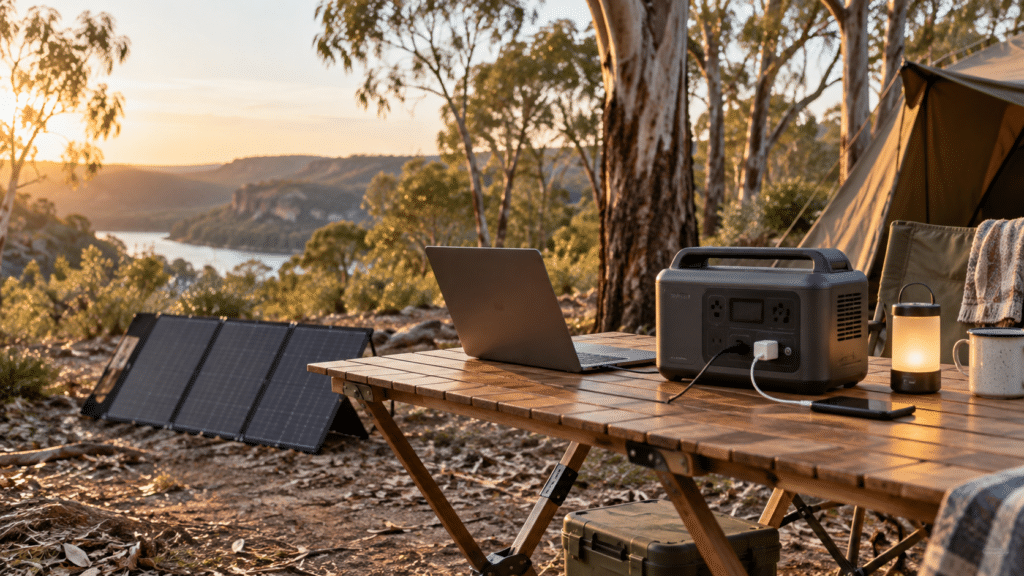
Portable power stations can be useful for convenience as well as resilience. They may suit a camping setup, a home office away from a mains outlet, outdoor entertainment, device charging or occasional work with low-power equipment. Their value often lies in making a particular situation easier, rather than trying to recreate the entire home’s electricity supply.
Backup requires more careful thinking. A station may help with selected equipment, but that does not mean it will automatically keep a home operating during an outage. Refrigeration, communications, medical equipment, heating, cooling and other priorities may have different power requirements and operating times.
If backup is the main reason you’re researching portable power, identify the essential devices first. Confirm that the proposed unit is appropriate for those devices, including their starting and running demands. Some equipment draws more power when it begins operating, and a product’s stated output may not tell the whole story.
- Separate essential loads from nice-to-have devices.
- Check starting and running requirements for equipment with motors or heating elements.
- Never assume portable power provides whole-home blackout protection.
- Follow the manufacturer’s instructions for connection, charging and use.
Where solar enters the conversation
Some portable power stations can be recharged from solar equipment. That can make them attractive for off-grid activities or for households wanting another way to replenish stored energy. But “solar-compatible” is not a complete system description.
The charging source, connection method, weather, placement, timing and product limits all affect the result. A portable station also remains a finite store of energy. If demand is higher than the available stored and incoming energy, it will eventually run down.
For that reason, assess the complete arrangement rather than buying a panel or portable station in isolation. The right question is how the source, storage and devices are expected to work together — and whether that matches the situation you actually have in mind. Any compatibility, installation or electrical safety question should be checked with the relevant manufacturer or appropriately qualified professional.
- Confirm that the charging source is compatible with the station.
- Consider where equipment will be placed and used.
- Allow for the difference between stored energy and incoming energy.
- Do not assume a portable setup replaces a fixed solar and battery system.
A better shortlist: five decisions before buying
A sensible shortlist starts with the devices, then moves to the product. Product comparisons can become a parade of capacity figures, but a large number is not automatically a better match if the unit is too heavy, awkward to recharge or poorly suited to the devices you need.
Think about the moments when the station must earn its place. A unit kept in a cupboard for emergencies has different practical requirements from one moved between the car, shed and home office. Controls, portability and storage arrangements may matter as much as raw capacity.
Also consider how the purchase fits with the rest of your household energy planning. If your wider goal is backup, electric transport, solar generation or managing growing household demand, a portable station may be one component of the conversation — or it may be a distraction from the more suitable fixed solution.
- Use-case: the exact devices and situations involved.
- Output: whether the station can support those devices safely and appropriately.
- Capacity: how long it may run the intended load under the relevant conditions.
- Charging: whether replenishment is practical for your routine.
- Ownership: storage, handling, maintenance and manufacturer support.
The useful next step is a household energy brief
Portable power stations are easiest to choose when the decision sits inside a clear household brief. Write down the task, the equipment, the location and the consequence if power is unavailable. That turns a vague search into a decision with edges.
I LOVE SOLAR helps households think through the energy they use now, the equipment they may add and the kind of professional guidance that may be appropriate. We don’t install portable power stations or hand everyone the same package. We help clarify the job before the buying conversation begins.
If your portable-power question is connected to a broader home energy plan, start there. A short, well-defined brief can prevent an expensive piece of equipment from becoming another object with a charging cable and no clear role.
- Describe the situation you want to improve.
- List the devices and their likely pattern of use.
- Separate portable convenience from fixed-home backup.
- Get product-specific and electrical advice where the setup requires it.